

If you’ve ever asked yourself, “How do I describe my mindset?”, you’re probably trying to understand the way you think, react, and see life.
And honestly, that’s a powerful question.
Most people go through life without ever reflecting on their mindset. They notice their emotions, habits, and struggles, but never stop to ask what kind of thinking is creating them.
Your mindset is not just your personality. It’s your mental approach to life. The way you interpret challenges, success, failure, pressure, and even yourself.
So when you describe your mindset, you’re really describing the lens through which you experience the world.
Why Understanding Your Mindset Matters
Learning to accurately describe your mindset says a lot about your self-awareness.
Some people describe their mindset as:
- Positive
- Growth-oriented
- Resilient
- Focused
- Open-minded
Others may describe it as:
- Negative
- Fearful
- Overthinking
- Self-doubting
- Fixed
None of these labels are permanent.
Hard truth: your mindset is not who you are. It’s what you’ve practiced mentally over time.
And once you understand your mindset clearly, you begin to understand why you react the way you do.
Want to understand the core of it first? Read: What Best Defines Mindset?
How Your Mindset Affects Your Life
Your mindset influences almost every part of your life without you noticing it.
It affects:
- Your confidence
- Your discipline
- Your relationships
- Your reactions to stress
- Your ability to grow
For example, if your mindset is constantly focused on fear and failure, you hesitate more. You avoid risks. You stay inside your comfort zone.
But if your mindset is focused on growth and learning, you become more adaptable. You recover faster from setbacks and trust yourself more.
This is why mindset matters so much in self-improvement.
Before your habits change, your thinking changes first.
The Real Root Causes of Your Mindset
Habits
Your daily habits slowly shape your mindset.
If your routine includes constant comparison, negativity, distractions, and inconsistency, your thinking becomes heavier over time.
But healthy habits like discipline, reading, reflection, and mindfulness strengthen mental clarity.
Related read: How to Build Self-Discipline from Scratch
Thinking Patterns
Most people repeat the same thoughts every day.
“I’m behind.”
“I’m not good enough.”
“What if I fail?”
Over time, these thoughts stop feeling like thoughts and start feeling like facts.
Hard truth: your mindset is built through repetition.
Environment
The people around you influence your mindset deeply.
If you constantly stay around negativity, criticism, or fear, your perspective slowly adapts to it.
But if your environment supports growth, self-awareness, and emotional balance, your mindset becomes healthier too.
You absorb more from your surroundings than you realize.
How to Describe My Mindset Honestly
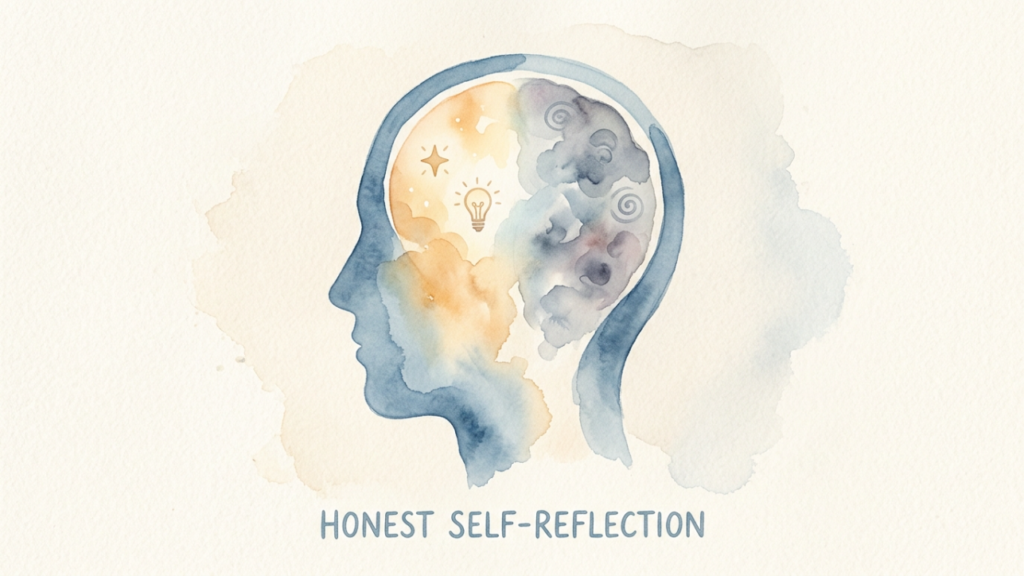
Here is a simple five-step process to help you describe your mindset with complete clarity:
Step 1: Observe your reactions
How do you react when things go wrong? Do you panic, avoid, or learn from it?
Step 2: Notice your dominant thoughts
Your repeated thoughts reveal your mindset clearly.
Step 3: Identify your habits
Your habits reflect your thinking patterns. Discipline, consistency, and self-awareness are all mindset indicators.
Step 4: Reflect on challenges
Do you see challenges as threats or opportunities to grow?
Step 5: Describe your perspective honestly
Instead of describing who you want to be, describe how you currently think. That honesty is where growth begins.
Not sure what mindset looks like in real life? See: What Is an Example of a Mindset?
The Mindset Shift You Need
You don’t need the “perfect mindset.”
You need awareness. This changes everything.
Many people try to force positivity while ignoring what they truly feel. But mindset is not about pretending.
It’s about understanding your mental patterns clearly enough to change them intentionally.
Hard truth: if you never reflect on your mindset, you repeat it automatically.
The moment you become aware of your thinking, you create the ability to change it.
And that’s powerful.
Real-Life Examples
The best way to describe your mindset is through honest, real examples:
Someone with a growth mindset might say:
“I believe I can improve through learning and consistency.”
Someone with a fixed mindset might say:
“I struggle with failure and often doubt my abilities.”
Another person may describe their mindset as resilient:
“Even when things go wrong, I try to move forward.”
Or someone may realize:
“I tend to overthink and assume the worst.”
These descriptions are not judgments. They are awareness. And awareness leads to change.
Curious how one word can capture all of this? Read: What Is Mindset in One Word?
Common Mistakes People Make
Describing mindset based only on emotions
Your mindset is deeper than temporary feelings.
Pretending to be positive
Real growth starts with honesty, not performance.
Thinking mindset cannot change
Mindset is learned and can be improved.
Ignoring daily habits
Your habits shape your perspective more than motivation does.
Final Thoughts
So, how do you describe your mindset?
You describe it through your perspective, your reactions, your habits, and your beliefs about yourself.
Your mindset is the story you repeatedly tell yourself about life. And if that story no longer supports your growth, it can be rewritten.
You’re not stuck with one way of thinking forever. You’re allowed to grow. You’re allowed to change. You’re allowed to see yourself differently.
And sometimes, self-awareness is the first real step toward transformation.
If you’re feeling lost about where to begin, start here: How to Get Your Life Together
If this made you pause and think, you’re already changing.