


Relationships shape our happiness, mental well-being, and daily lives more than almost anything else. Whether you’re in a husband and wife relationship, a new romantic partnership, or trying to improve a long-term serious relationship, understanding what makes love healthy—and what destroys it—is essential.
In this complete guide, we explore:
Table of Contents
Let’s dive into everything you need to build love that lasts.
What Are the 5 Qualities of a Healthy Relationships?
While every relationship is different, solid partnerships share five universal qualities that form the foundation of love, trust, and long-term well-being.
1. Trust
Trust is the backbone of a healthy relationship. Without trust, every conversation becomes tense, and every misunderstanding becomes a fight. Trust makes love feel safe instead of stressful.
2. Communication
Healthy couples talk openly about feelings, needs, plans, fears, boundaries, desires, and even mistakes.
Good communication means:
- Listening to understand
- Speaking without attacking
- Expressing needs clearly
- Being honest even when it’s hard
3. Respect
Respect means valuing each other’s boundaries, opinions, dreams, and individuality.
In respectful relationships, partners feel appreciated instead of judged.
4. Emotional Support
A good relationship feels like a safe emotional home. You support each other through stress, dreams, challenges, and insecurities.
5. Shared Values and Effort
Love alone isn’t enough. The strongest couples share values (loyalty, family, honesty, ambition) and put effort into keeping the relationship healthy.
Attachment Styles and Their Impact on Love
Your attachment style influences how you love, communicate, fight, and heal.
1. Secure Attachment
You trust your partner, communicate honestly, and expect healthy love.
2. Anxious Attachment
You fear rejection, overthink, and seek constant reassurance.
This often leads to relationship anxiety and emotional overwhelm.
3. Avoidant Attachment
You fear intimacy, distance yourself emotionally, and struggle with vulnerability.
4. Fearful Avoidant (Disorganized)
You want closeness but fear getting hurt, causing push-pull dynamics.
Healthy relationships are possible with ANY attachment style but understanding your style helps you break negative patterns and create emotional safety.
What Are 10 Signs of a Healthy Relationship?
Healthy love doesn’t feel like guessing, fear, or pressure. It feels supportive, respectful, and secure. Here are the top 10 signs your relationship is strong:
1. You communicate instead of shutting down.
You talk through problems calmly and honestly.
2. You feel emotionally safe.
There is no fear of judgment or rejection.
3. You trust each other fully.
No secret checking of phones, no constant jealousy, no doubts.
4. You enjoy spending time together.
Your presence comforts each other, even in silence.
5. You respect boundaries.
You allow each other space, hobbies, and independence.
6. You resolve conflict with respect.
No name-calling, stonewalling, or belittling.
7. You support each other’s growth.
A healthy partner encourages your dreams—not competes with them.
8. You share responsibilities fairly.
This is essential in marriage and long-term relationships.
9. You feel appreciated.
Little gestures—thank you’s, affection, compliments—go a long way.
10. You choose each other daily.
Not because you have to, but because you want to.
What Is the Most Common Reason Relationships Don’t Work?

While there are many reasons relationships break down, the #1 cause is:
Poor Communication
Communication failures lead to:
- Misunderstandings
- Pent-up resentment
- Emotional distance
- Relationship anxiety
- Arguments that repeat over and over
In many unhappy marriages, couples don’t fall out of love they stop communicating with kindness.
When communication dies, everything else slowly collapses.
What Are the 4 Things That Destroy Relationships?
These four behaviors are the biggest destroyers of love. Even strong couples can break under their weight:
1. Criticism
Attacking your partner’s character (“You never care about anything!”) instead of discussing behavior hurts deeply.
2. Contempt
Sarcasm, mocking, eye-rolling, or belittling.
Contempt is the #1 predictor of divorce according to relationship experts.
3. Defensiveness
Instead of listening, defensive partners react by blaming or escalating the problem.
4. Stonewalling
Shutting down, ignoring, or avoiding conversation.
This kills emotional intimacy.
If any of these appear regularly, the relationship will weaken over time unless repaired.
The Psychology Behind Healthy and Unhealthy Relationships
Healthy relationships aren’t random they follow predictable psychological patterns.
The foundation of a strong relationships lies in:
• Emotional Regulation
Partners who can manage anger, stress, or insecurity communicate better and fight less.
• Secure Attachment
People who feel secure emotionally connect deeply and resolve conflicts calmly.
• Healthy Self-Esteem
When both partners feel worthy, they don’t seek constant validation or behave defensively.
• Empathy
Understanding each other’s feelings reduces conflict and strengthens intimacy.
Unhealthy relationships, on the other hand, often arise from:
- Poor emotional control
- Insecurity
- Unhealed trauma
- Fear of abandonment
- Lack of boundaries
Understanding the psychology behind behavior helps couples grow with compassion instead of judgment.
What Are 10 Signs of an Unhealthy or Toxic Relationship?
Toxic relationships can be draining, confusing, and emotionally painful. Here are 10 clear signs to watch for:
1. Constant jealousy
Not normal concern obsessive suspicion.
2. Controlling behavior
Monitoring your phone, limiting friends, or dictating choices.
3. Walking on eggshells
You’re scared to share feelings because of their reactions.
4. Manipulation or guilt-tripping
They twist situations to make you feel at fault.
5. Lack of respect
Insults, dismissing your feelings, shouting, or mocking.
6. Hostile communication
Yelling, name-calling, threats, or silent treatment.
7. No personal space
A healthy relationship supports independence.
8. Gaslighting
They deny your experiences, making you doubt yourself.
9. Emotional or physical cheating
Emotional cheating can hurt just as much as physical.
10. You feel drained instead of supported
A healthy relationship builds you; a toxic one breaks you.
If these signs appear frequently, it’s a warning to reflect, set boundaries, or seek help.
What Are the Qualities of a Successful Relationship?
Successful long-term relationships go beyond romance. They thrive on:
1. Partnership
You solve problems together instead of competing or blaming.
2. Emotional intimacy
Having meaningful conversations, sharing fears, and being open.
3. Patience and forgiveness
No one is perfect. Strong couples apologize, forgive, and move forward.
4. Equality
No power imbalance both partners have a voice.
5. Consistency
Small daily acts of love matter far more than big once-a-year gestures.
Successful relationships are built, not found.
What Is the #1 Thing That Destroys Marriages?
The biggest marriage destroyer is:
Emotional Disconnection
When a husband and wife stop sharing emotions, affection, vulnerability, and appreciation, the marriage becomes cold. This emotional distance leads to:
- Cheating
- Resentment
- Loneliness within marriage
- Arguments
- Feeling more like roommates than partners
Most affairs start not because partners want someone else—but because they feel unheard, unnoticed, or emotionally neglected.
Red Flags vs. Green Flags in Relationships
These keywords rank extremely well because readers and Google LOVE them.
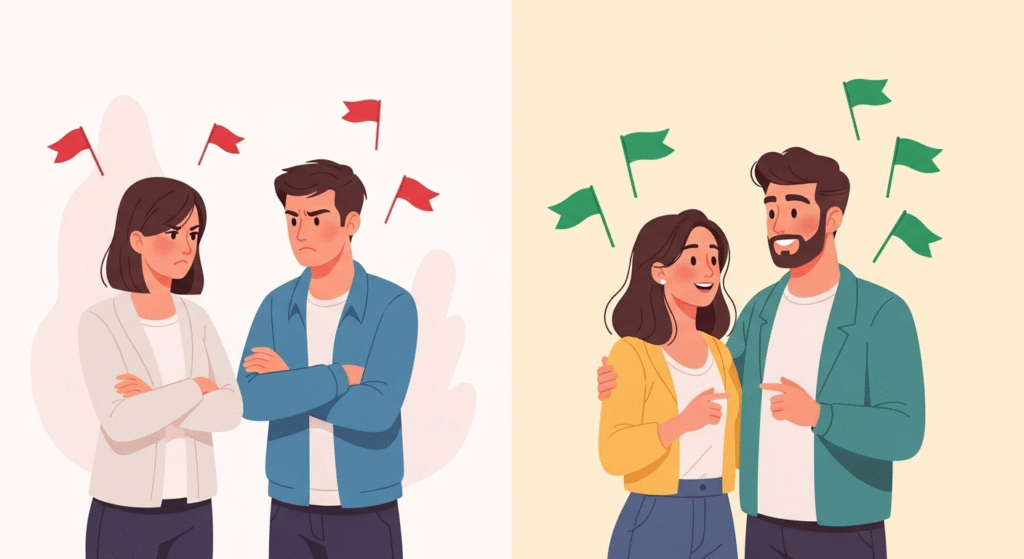
RED FLAGS (Warning Signs)
🚩 Controlling behavior
🚩 Constant jealousy
🚩 Emotional manipulation
🚩 Blame-shifting
🚩 No accountability
🚩 Avoiding communication
🚩 Love bombing then withdrawing
🚩 Gaslighting
GREEN FLAGS (Healthy Signs)
💚 Respectful communication
💚 Emotional safety
💚 Consistency
💚 Shared efforts
💚 Accountability
💚 Kindness even during conflict
💚 Mutual independence
💚 Trust and transparency
Red flags drain your well-being.
Green flags nurture your happiness.
Conflict Resolution Techniques That Actually Work
Conflict is healthy—if handled correctly.
Use These Proven Techniques:
1. The 20-Minute Rule
If emotions are high, take a 20-minute break to cool down.
2. “I Feel” Statements
Instead of “You never listen,” say,
“I feel unheard when I’m interrupted.”
3. Listen to Understand, Not Respond
Most people listen to argue—not to understand.
4. Repeat Back What You Heard
This prevents miscommunication.
5. Solve One Problem at a Time
Avoid bringing up old issues during a new argument.
Healthy conflict builds stronger bonds.
What Is the Golden Rule of Relationships?
Treat your partner the way you want to be treated.
This includes:
- Respect
- Support
- Appreciation
- Kindness
- Honesty
- Emotional presence
When both partners practice the golden rule, the relationship becomes a place of safety and love—not conflict.
Relationship Problems & How to Solve Them
Every relationship faces challenges. What defines healthy love is how you respond to them.
Here are solutions for the most common relationship issues, using your keyword list:
1. Communication Problems in Marriage
Bad communication leads to:
- Misunderstandings
- Arguments
- Emotional distance
- Unhappy marriage
How to fix it:
✔ Listen without interrupting
✔ Use “I feel” statements instead of blame
✔ Set weekly check-ins to talk about feelings and plans
✔ Validate each other’s emotions
2. Cheating in a Relationship
Cheating isn’t always physical. Emotional cheating can be just as damaging.
Why people cheat:
- Emotional disconnect
- Loneliness
- Validation seeking
- Lack of communication
- Unresolved conflicts
How to move forward:
✔ Honest conversation about what happened
✔ Couples therapy
✔ Setting clear boundaries
✔ Making amends with consistent actions
✔ Rebuilding trust slowly and consistently
3. Rebuilding Trust in a Relationship
Trust is fragile but can be rebuilt with:
- Transparency
- Consistency
- Accountability
- Open communication
- Patience
Trust is earned through actions, not words.
4. Relationship Anxiety & Anxious Attachment
Anxious attachment causes:
- Overthinking
- Fear of abandonment
- Clinginess
- Constant reassurance seeking
How to manage it:
✔ Practice self-soothing
✔ Communicate your needs calmly
✔ Build independence
✔ Avoid reacting impulsively
✔ Work on emotional security
5. Controlling Relationship Behavior
Control is a red flag. It may be emotional, financial, or social control.
Solution:
✔ Identify controlling patterns
✔ Set boundaries
✔ Seek outside support
✔ Rebuild personal autonomy
6. Toxic Relationship Patterns
Toxicity grows through:
- Blame
- Disrespect
- Manipulation
- Jealousy
- Insecurity
Healthy relationships require mutual effort to break toxic cycles.
The Role of Mental Health & Well-Being in Relationships
Your mental health affects your relationship more than you realize.
Mental health challenges can lead to:
- Irritability
- Withdrawal
- Overthinking
- Lack of emotional availability
- Low libido
- Communication struggles
Healthy relationships require:
✔ Emotional stability
✔ Stress management
✔ Self-awareness
✔ Self-care
✔ Vulnerability
When both partners support each other’s mental well-being, the relationship becomes a space of healing—not stress.
How to Better Your Relationship: Tips For Healthy Relationships
Small changes create big improvements, Here are the healthy relationships tips:
Tips on healthy relationships to strengthen your relationship:
- Show gratitude daily
- Put your phone away during conversations
- Give affection (touch, hugs, compliments)
- Spend intentional quality time
- Resolve conflicts before they pile up
- Support each other’s dreams
- Maintain trust with honesty and openness
Healthy love is built day by day.
Conclusion: Healthy Relationships Create a Healthier Life
A healthy relationship strengthens your emotional well-being, mental health, confidence, and overall happiness. An unhealthy or toxic relationship does the opposite—creating stress, insecurity, anxiety, and emotional exhaustion. The difference lies in awareness, communication, and the willingness to grow together.
Love isn’t luck; love is effort. It’s built through kindness, emotional safety, respect, and compassion. When both partners show up with honesty and commitment, any relationship can evolve into something truly beautiful.
Your love life begins to transform the moment you:
- Understand your patterns
- Break toxic cycles
- Build emotional safety
- Communicate with respect
- Put effort into connection
- Choose love intentionally, every day
Healthy relationships aren’t perfect—they are intentional. With self-awareness, open communication, and a focus on emotional well-being, you can create a partnership that not only lasts… but makes your entire life healthier and happier..




One Response